No-Code Works… Until Systems Start to Scale


No-code tools have changed the way products are built. They’ve made it possible for founders, designers, and teams to launch ideas faster than ever, without waiting on engineering resources or complex development cycles. For early-stage products, this is a superpower. But there’s a point where things start to shift.
The speed advantage eventually meets complexity
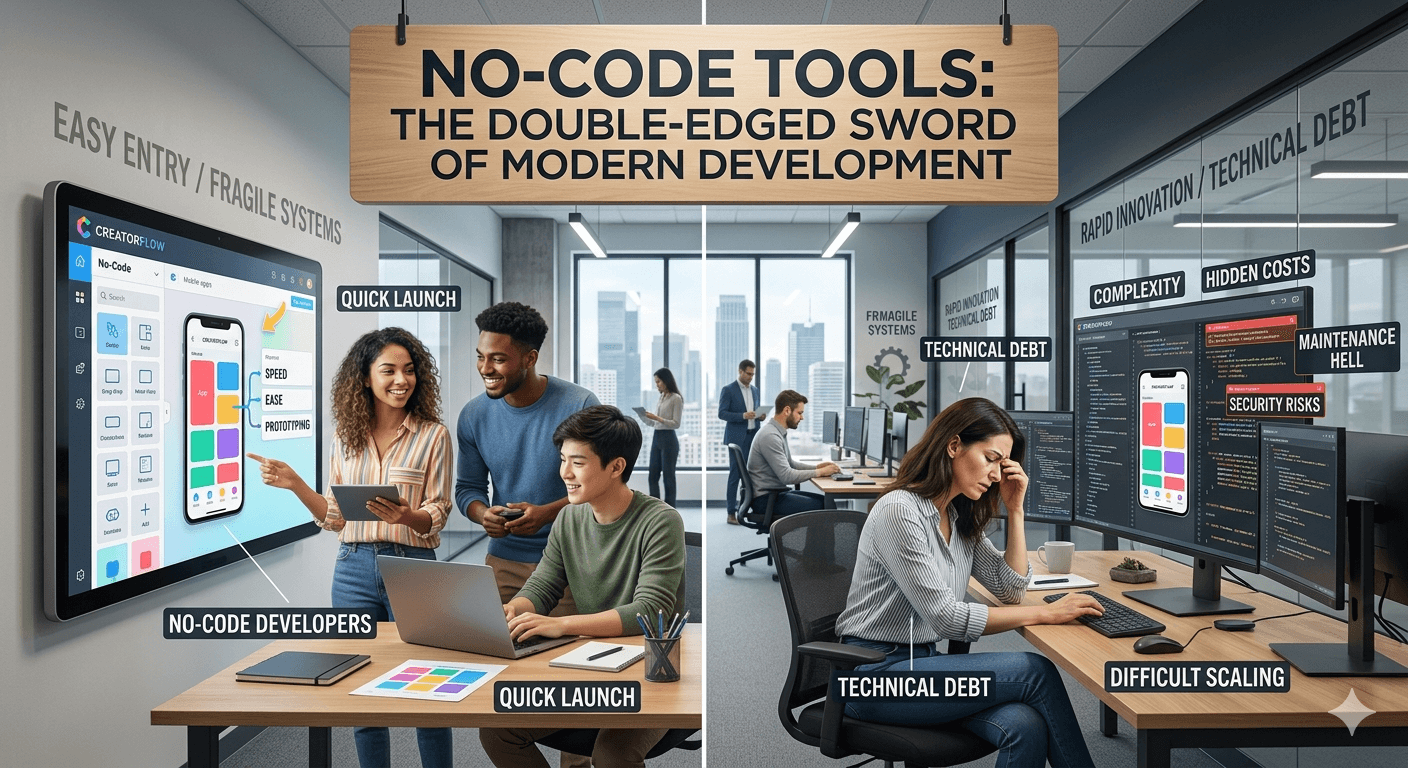
At the beginning, no-code feels like freedom. You can build landing pages in hours, automate workflows in minutes, and test ideas without writing a single line of code.But as your product grows, so does everything around it: * More users * More data * More edge cases * More integrations * More internal processes And suddenly, the very tools that helped you move fast start to show their limits. What used to be flexible becomes fragile. What used to be quick becomes difficult to maintain.
The hidden cost of “just connecting tools”
No-code systems often rely on multiple platforms stitched together—automation tools, databases, form builders, analytics dashboards, and third-party integrations. Individually, they’re powerful. But at scale, this creates: * Fragmented data * Hard-to-trace workflows * Limited performance control * Dependency on multiple external systems * Growing operational risk When something breaks, it’s not always obvious where or why.
Scaling isn’t just about building more, it’s about building sustainably
This is the real turning point. Scaling a product isn’t just about handling more users. It’s about maintaining clarity, control, and consistency as complexity increases. At that stage, teams often start to rethink their architecture: * What should remain no-code? * What needs to be rebuilt more robustly? * Where is flexibility more important than speed and vice versa? The goal isn’t to abandon no-code entirely. It’s to recognise where it stops being the right tool.
The hybrid future is already here
Most mature products don’t sit in one camp. They combine: * No-code for speed and experimentation * Custom code for performance and scale * Structured systems for reliability and governance This hybrid approach allows teams to move quickly without building themselves into a corner.
Final thought
No-code doesn’t fail. It just has a ceiling. The teams that scale successfully are the ones that recognise that ceiling early and design beyond it before it becomes a problem.
Related Insights

·
11 min read
Modernising Financial Apps: Next-Gen API Integration

·
7 min read
How Fixed Scope Sprints Accelerate Product Roadmaps
·
5 min read
Fixed-Price vs. Hourly Billing: Protecting Your Runway

·
3 min read
VC Technical Due Diligence Checklist for Startup Apps

·
2 min read
Building Scalable Fintech Apps: Security & High Throughput

·
4 min read
The AI Prototype Trap

·
3 min read
Why AI Agents Fail Without Product Structure

·
5 min read
Good UX is System Design, Not Interface Design

·
3 min read
Cybersecurity Is No Longer Just an IT Problem

·
7 min read
AI Is Becoming The Expensive Option
·
8 min read
UX for Legal Claim Funnels

·
8 min read
Accessibility Is Product Quality

·
3 min read
Serverless Architecture on AWS is a Key Differentiator
·
3 min read
No-Code Tools: The Double-Edged Sword of Modern Development