Serverless Architecture on AWS is a Key Differentiator
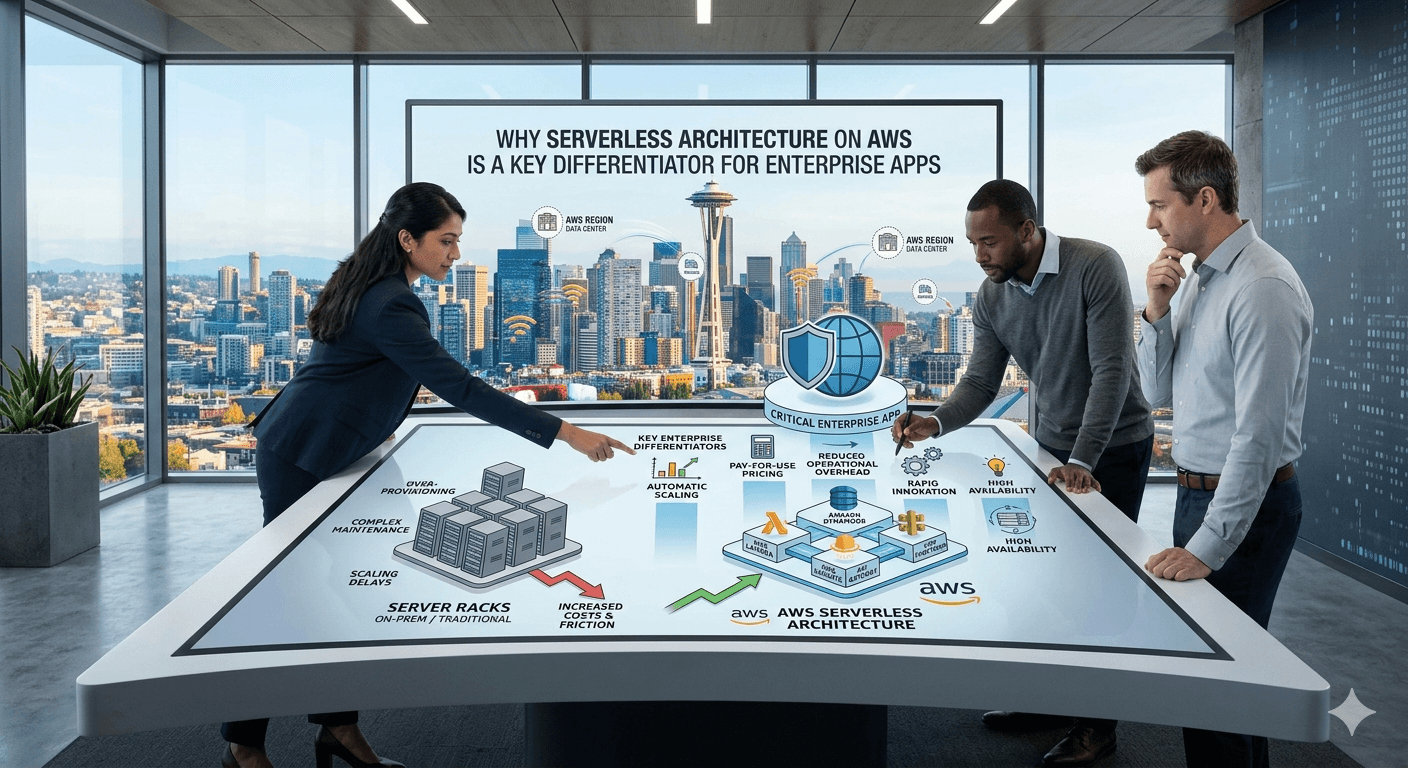

In today’s competitive enterprise software market, the ability to scale efficiently, innovate rapidly, and reduce operational complexity is paramount. Many companies are turning to serverless architectures on AWS as a strategic advantage, allowing them to build enterprise-grade applications that can grow seamlessly with demand. Serverless computing, exemplified by AWS services such as Lambda, DynamoDB, API Gateway, and Step Functions, abstracts away the underlying infrastructure, enabling developers to focus on writing code rather than managing servers. This approach delivers immediate benefits for enterprises: rapid deployment cycles, lower operational overhead, and the ability to respond dynamically to unpredictable workloads. One of the primary advantages of serverless is elastic scalability. Traditional server-based architectures require careful planning, provisioning, and often over-provisioning to handle peak traffic. With serverless, compute and storage resources automatically scale to meet demand. Enterprises can serve millions of users globally without the upfront investment in infrastructure, ensuring reliability even during sudden spikes in usage. Serverless also reduces total cost of ownership (TCO). Enterprises only pay for actual compute time and resource usage, rather than pre-allocated servers running idle. This efficiency allows organisations to redirect capital toward innovation, product improvements, and customer experience enhancements, rather than maintaining costly on-premises or cloud infrastructure. From a development perspective, serverless architectures accelerate time to market. Developers can iterate faster by building microservices that execute discrete tasks independently, leveraging AWS’s managed services for authentication, storage, messaging, and more. This modularity not only improves maintainability but also enables cross-functional teams to collaborate without bottlenecks. Security and compliance, often a concern for enterprise applications, are strengthened in the serverless model. AWS handles patching, updates, and infrastructure security, allowing enterprise teams to focus on application-level protections and regulatory compliance. Services such as AWS IAM, Shield, and WAF integrate seamlessly into serverless applications, giving enterprises confidence that scaling does not compromise security posture. Perhaps most importantly, serverless architectures support innovative business differentiation. Enterprises can rapidly prototype new features, integrate AI/ML workflows, and deliver personalised experiences without the delays associated with traditional monolithic architectures. The ability to scale on demand and iterate quickly becomes a competitive edge in markets where responsiveness and reliability are critical. While serverless isn’t a silver bullet—developers must carefully design stateless functions, manage cold starts, and monitor costs—the benefits for enterprise-scale applications are compelling. Companies that adopt serverless on AWS position themselves to deliver highly reliable, scalable, and cost-efficient solutions that meet modern business demands. In an era where agility and scale define market leadership, serverless architecture on AWS is no longer just a technical choice—it is a strategic differentiator that enables enterprises to innovate faster, scale smarter, and compete more effectively.
Related Insights

·
11 min read
Modernising Financial Apps: Next-Gen API Integration

·
7 min read
How Fixed Scope Sprints Accelerate Product Roadmaps
·
5 min read
Fixed-Price vs. Hourly Billing: Protecting Your Runway

·
3 min read
VC Technical Due Diligence Checklist for Startup Apps

·
2 min read
Building Scalable Fintech Apps: Security & High Throughput

·
4 min read
The AI Prototype Trap

·
3 min read
Why AI Agents Fail Without Product Structure

·
5 min read
Good UX is System Design, Not Interface Design

·
3 min read
No-Code Works… Until Systems Start to Scale

·
3 min read
Cybersecurity Is No Longer Just an IT Problem
·
8 min read
Accessibility Is Product Quality