No-Code Tools: The Double-Edged Sword of Modern Development
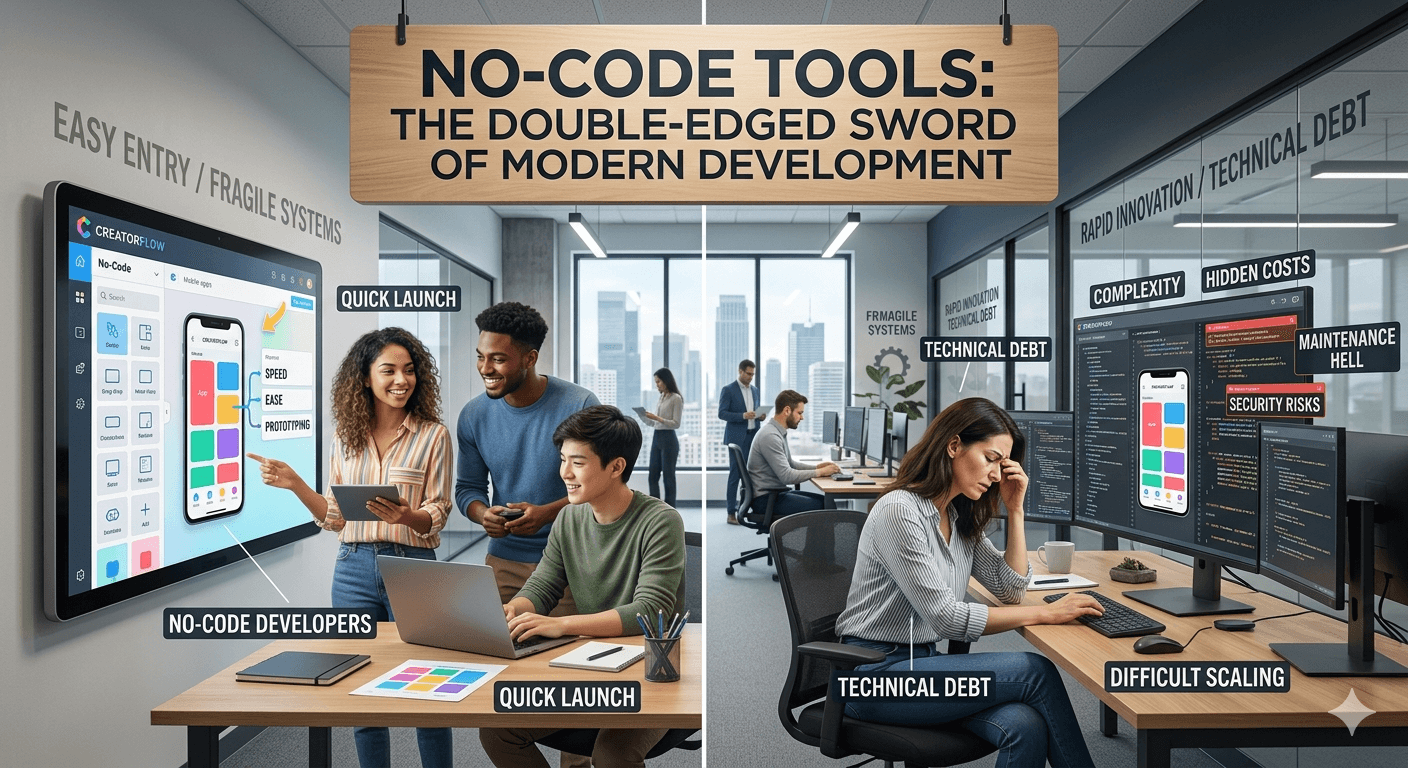

No-code platforms promise to democratise software creation, allowing anyone to build apps, websites, and workflows without writing a single line of code. From start-ups to enterprise teams, these tools offer an enticing shortcut: rapid prototyping, lower upfront costs, and reduced reliance on specialised developers. But while the advantages are clear, the downsides of no-code tools are becoming increasingly apparent. One of the most significant limitations is scalability. No-code platforms often abstract complex logic into simplified interfaces, which can make it difficult—or even impossible—to implement highly customisable solutions. As projects grow, teams may find themselves constrained by the platform’s built-in features and workflows, forcing expensive migrations to traditional codebases. Security is another concern. Because no-code platforms handle much of the underlying infrastructure, developers have less control over data handling, encryption, and compliance. Vulnerabilities in the platform itself can ripple through every project built on top of it, leaving organisations exposed. Performance can also be a hidden bottleneck. Many no-code tools generate code behind the scenes, which is often less efficient than hand-written alternatives. For applications with heavy computation, complex integrations, or high traffic, this can result in slower load times, increased costs, and poor user experience. Then there is the question of vendor lock-in. No-code solutions are typically proprietary, and exporting projects to another platform—or to a traditional codebase—can be difficult and time-consuming. Companies that grow dependent on a single provider risk losing flexibility or incurring steep costs if the platform changes pricing, features, or ceases operations entirely. Even from a development perspective, no-code can limit collaboration and team growth. Junior developers or citizen builders may quickly become reliant on the platform’s abstractions, missing opportunities to learn fundamental coding skills and best practices. Over time, this can create knowledge gaps and a workforce less equipped to handle complex, custom engineering challenges. Despite these drawbacks, no-code tools are not inherently bad—they excel for small projects, rapid prototyping, and automating routine workflows. But organisations need to weigh convenience against long-term limitations, particularly if they anticipate growth, complex integrations, or regulatory obligations. In the end, no-code is a powerful accelerator—but it is far from a universal solution. Teams that ignore its constraints may find that the same shortcut that saved time today could become a costly bottleneck tomorrow.